


 Home
Home Blog
Blog Fashion
 Forum
Forum Gallery
 SHOP
SHOP About
About Advertise






 Discuss anything in our forums!
Comebacks For Short Jokes.
Six Ways To Handle Height-Related Insults And Workplace Banter. (Updated For 2026)
Published November 2015
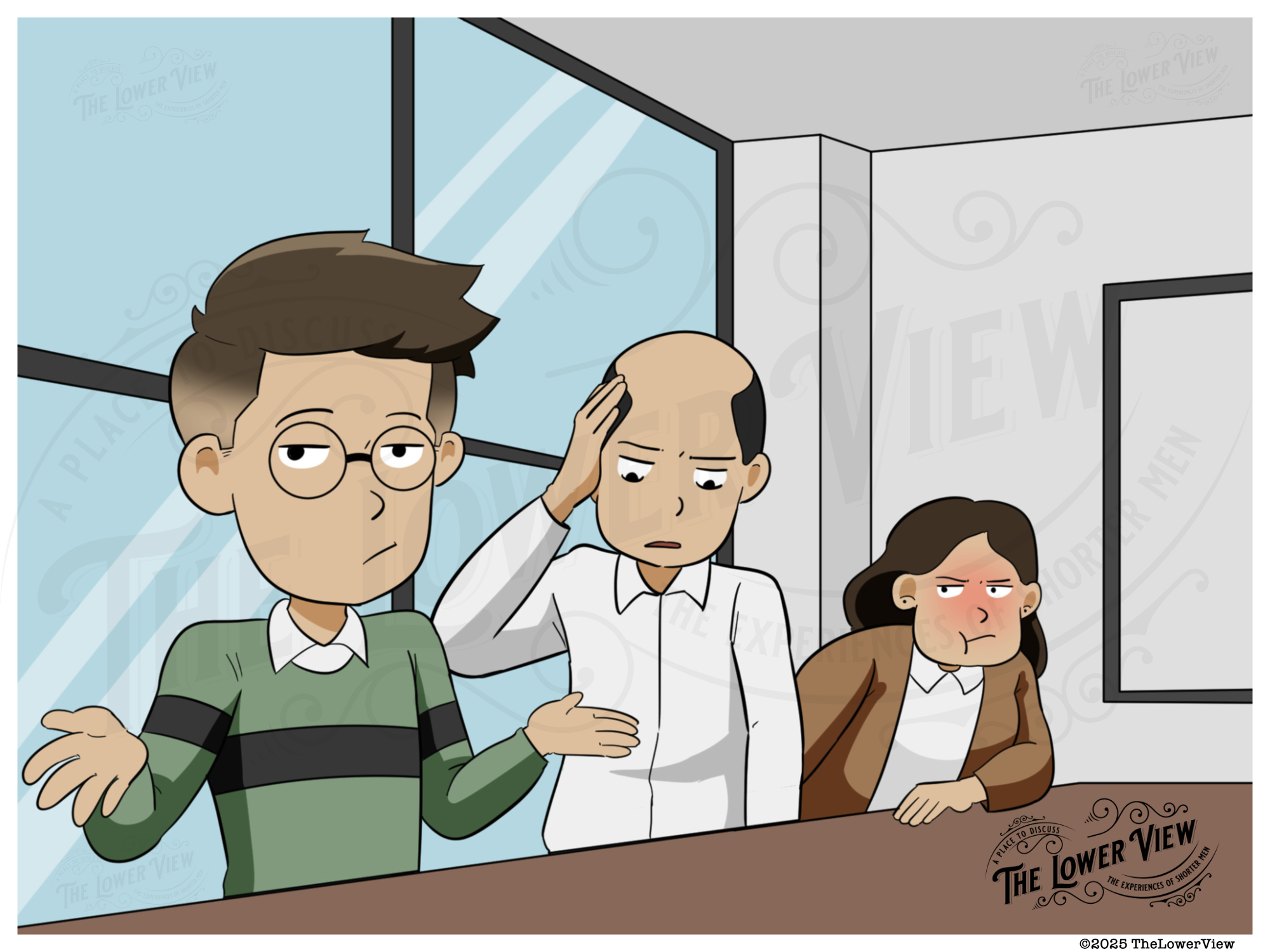
Disclaimer: This article is for general informational purposes and isn't legal advice. Employment and anti-discrimination laws vary by location.
I was motivated to revisit this topic some ten years later due to a comedy episode that I recently saw (again, it was that funny) where now disgraced comedian Louie C.K. (look it up, I won’t get into that here) does a stand-up bit in which he talks about how a racial slur directed at him wouldn't hurt his feelings. To repeat verbatim, he said in response to the slur, he’d think to himself (sarcastically), “Uh… ruined my day”, followed by a more explicit punchline (we’d rather keep this article safe for work). Pretty powerful bit — not just because of the language, but because it reinforces the idea of there being an unsaid (though it’s being said a lot louder these days) social hierarchy. Completely undeserved, of course, and not indicative of anyone’s character, there is a perceived pecking order, with some people placed higher and others lower.
TABLE OF CONTENTS
▪ INTRODUCTION▪ THE IGNORE AND DISARM▪ THE MAKE THEM REPEAT AND EXPLAIN▪ THE JOKE BACK AT THEM▪ THE BELOW THE BELT▪ THE CONFRONTATION▪ THE DISENGAGE AND ESCALATE▪ CONCLUSION
INTRODUCTION
Let’s take it over to height. About ten years ago (which ironically was not too long after that stand-up comedy special first aired), during the first Trump presidential campaign, on the debate stage, Donald Trump repeatedly berated fellow presidential hopeful Marco Rubio by calling him “Little Marco” — over and over again. To the point where in just about every YouTube video or social media post I could find, commenters were referring to him by the same nickname. His policies would sometimes take a back seat to the height obsession — after all, he was 'Little Marco'! Ironically, in the present, despite these spats, Rubio is now his Secretary Of State.
Well, why the intro? As mentioned, there is an ingrained social hierarchy when it comes to height. If you’re north of six feet, you may experience many of the privileges awarded by the ever-present halo effect. If you’re south of 5’8”, expect a barrage of insults that never quite goes away. Now, as we saw with the Marco Rubio example, it doesn’t quite end after high school. In fact, it can and may follow you into the workplace, and even into “friendship banter”. After a while, this will get extremely annoying. In some cases, it may affect the quality of life for many on the receiving end. In the workplace, this is unacceptable, but how can you deal with it? In most places, there is little to no specific legal recourse if someone puts you down for your height regularly… and most people will tell you to be able to take a joke (anti-harassment laws do exist, but in most places, height isn’t considered a “protected characteristic”).
Okay, so with that introduction, I am going to outline six approaches to dealing with height insults. While this article will retain the title of “Comebacks For Short Jokes”, this will now read as a sort-of guide on how to deal with height-related insults in the workplace and in your adult life — and in some cases, how to come back. We’ll lay out the approaches along with their pros and cons. Okay, without further delay, gentlemen, welcome to “Comebacks For Short Jokes”.
THE IGNORE AND DISARM
This one will get the most eye rolls because it’s the tamest and the path of least resistance. Taking a page from Kevin Hart’s interview with Oprah, when asked how he dealt with height jokes, he said, “I did it [told the joke] before they did.” He followed up by saying, “anything the person thinks that they can say, I disarm you of it by saying it myself” — essentially, a method of taking the power away from the derider via self-deprecation.
Now, why this method? First off, in a sense Hart was correct. By going along with the joke, you’ve taken away their ammo. For some people (keyword: “some”), it demonstrates that you are comfortable with your, umm, “shortcomings..
I’m not going to lie to you, this method is a thorn in my side, and I personally never go this route. For one, you’re telling your tormentor (read: bully) that it is okay to disparage you. If this person is the party-hardy extroverted type, you can almost bet they’ll do it again, especially if they have a larger audience. It also sends a message to other people that you are a target for clowning.
Do you want to be the clown in your friend group? When those people introduce you to new people, or in the case of the workplace, when someone gets hired, guess who the whipping boy will be. I’d personally avoid this method at all costs.
Still yet, this works for some people. Honestly, I’d say to play it by ear. I loathe being the “jester” and I would advise against it. People who refuse to respect boundaries are the worst with this method because they will convince you that this is the way. I say, “No-Way”.
THE MAKE THEM REPEAT AND EXPLAIN
Making the comparison to race again (I know this comparison will upset readers, but bear with me), I once watched a woman with a Ph. D. on a podcast talk about how she makes people repeat themselves in work situations when encountering a microaggression or supposed innocent, light-hearted “joke”.
It works like this: They say their insult, you then say, “I’m sorry, I didn’t understand. Can you repeat?” Especially if this is in front of a crowd, and if it is a high stakes situation (the workplace, a meeting, or even a get-together of people they have great respect for), they may back off. If they don’t, then play dumb and keep asking them to repeat themselves. Insist that you still don’t get it, even if they go over every detail and explain the punchline.
This form of disarmament is better in my opinion because they get to process the hurt they may have caused (or the level of immaturity, let’s assume you have skin thicker than steel) in real time by exposing their intent. If there’s an audience, it then becomes clearer to everyone.
Of course, the person may not care that they had to explain themselves (there’s always that possibility), and if they’re truly a jerk, they may keep going over it repeatedly with you, making you even the bigger butt of the joke (a major jerk move). As always, your mileage will vary, but in my experience, this approach usually works pretty well, especially in a work environment.
See Also: Top 25 Short CEOs, Business Leaders and Entreprenuers
THE JOKE BACK AT THEM
Buckle your seatbelts — you better be funny. This is analogous to “the Dozens”, the classic insult game where you keep going and going and going until the other person gives up. When I say you better be funny, I mean you need to be able to think quickly and have a huge bag of jokes – no exceptions (and your skin needs to be thicker than a brick wall).
Going back to the social hierarchy that we spoke about earlier and the Marco Rubio example, taller people usually know that they have the advantage, so your comebacks need to be that much better.
I’ve used this method, but it works best with good friends who have your best interest at heart. I would be wary of using this in the workplace, but if you really trust the person (and I mean really, really, really trust) it could also work.
If you are annoyed by the insults, you can jab at some of their insecurities. If you have the better banter, then you win. If not, then you obviously lose — and you can lose big. But even if you win the exchange, remember, people are watching, and this can still put you in the “it’s okay to joke on that short guy” category. Proceed with caution.
THE BELOW THE BELT
Be ready for anything, and I say this jokingly (but not really): be ready to throw hands or deal with a lot of anger in return. Sometimes, people don’t get how impactful height insults can be, especially because by this age, you’ve heard it enough times. If it gets to a situation where this is all that person does — uses you as a punching bag, and it affects your quality of life, then hitting them below the belt may be the only way you can make them understand that same level of pain.
Here's an anecdote. I had a friend who had a friend who, for whatever reason, always had the need to crack a joke at my expense. It would be at the most unexpected times and she’d laugh harder than anyone else in the friend group (even the others thought it was a bit much). This “person” (not the word I want to use, but I want to stick to family-friendly here) would not quit. So… I had to go below the belt to get this person to shut the… umm, front door.
She wasn’t the most attractive woman (and no, I am not trying to insult her for her looks), and from what I knew about her, she always had trouble keeping romantic relationships. One day at a friend get-together, she went in for the kill. I noticed that she had a mole, one that was quite big near the bottom of her chin, so I simply said, “Yeah, that’s why you have that big mole.” Oh my god, she lost it, and when I say lost it, I mean all of her marbles (you could hear the marbles moving across the floor). The number of expletives that left her mouth in the ensuing minutes could give Urban Dictionary a run for its money. All I could remember after the cursing began to subside was her saying (with a major attitude), “I know I’m beautiful, I know I’m beautiful.” Yeah, okay moly-poly (sorry, but she took me there).
You know what, though? I’ll be damned. From that day forward, she stopped. You might say, “Hey, what you said is petty, and you shouldn’t be endorsing that kind of behavior!” I’m not saying it wasn’t petty, but I implore you to offer shorter men the same grace you expect to receive when dealing with stress and personal attacks — in this case constant personal attacks. You would, or probably do, know people who would stand up for themselves or fight fire with fire right? The issue is that for some reason when shorter men do this, it’s automatically “Napoleon Complex!”, when others do it, it’s just them “standing their ground”.
Now remember what I said about being able to throw hands — she cursed me out to hell high, but that was it. Not everyone will make that their emotional limit. Some may want to fight you, and some may take it even further. Take heed of that.
My advice if you go this route is to know your audience, and I mean really well. Also, with that, have a deep knowledge of the law where you reside. Depending on where you are, I’d strongly refrain from doing this in the workplace. You may not receive any HR support whatsoever, particularly in jurisdictions where height is not specifically protected by law. New York City and Michigan, for example, prohibit certain forms of height discrimination. There are anti-harassment laws on the books in many places that may apply depending on the circumstances, but from my point of view, it may be a tougher fight than going up against more “traditional” kinds of harassment. Your mileage in this case may be non-existent.
See Also: Making The Napoleon Complex Work For You
THE CONFRONTATION
In life, as an adult, you need to be able to bask in your discomfort. In my humble opinion, this might be one of the healthiest life approaches because it teaches you to work through conflict.
With that, just go up and tell the person privately that you don’t appreciate their language or being made the target of their jokes. Be prepared, however — this may or may not go over well depending on who it is. In the workplace, the person may listen since their livelihood is on the line. Just be forewarned: if you take this approach and the outcome works in your favor, you better never put yourself in the position of cracking jokes at someone else’s expense. They — and potentially others if your detractor tells them about it — will remember that conversation.
The downside to this, however, is that some Type-A personalities may interpret this as a weakness (and maybe even tell you that to your face then and there!). Worse yet, they may ostracize you, ramp up the rhetoric, or become an even bigger bully, making you even more uncomfortable.
On the flip side, they may just respect you a bit more for confronting them head-on and for keeping it between you and them. Again, pal, your mileage may vary. You just never know.
THE DISENGAGE AND ESCALATE
This is the biggest short-term fix, but it may come back to bite you. This approach is where you just cut them off, and I mean completely. If this is a friend rather than a coworker, that’s relatively easy.
There has been a lot of writing on the phenomenon of “ghosting”, but let me tell you, especially at my age, peace is my main aim. If you disrupt my peace, I will have no patience. If you don’t fall into the category of a friend whom I can have friendly banter with, I don’t want to hear your short joke nonsense — simply because I know that my jokes on any physical traits you may possess that others may interpret as “defective” won’t go over well.
That said, this would probably not work well in the workplace, simply because, unless you work on different floors, in different departments, or in different locations, you will have to engage with that person at some point, and that awkwardness may affect productivity. Remember, your co-workers and management are watching!
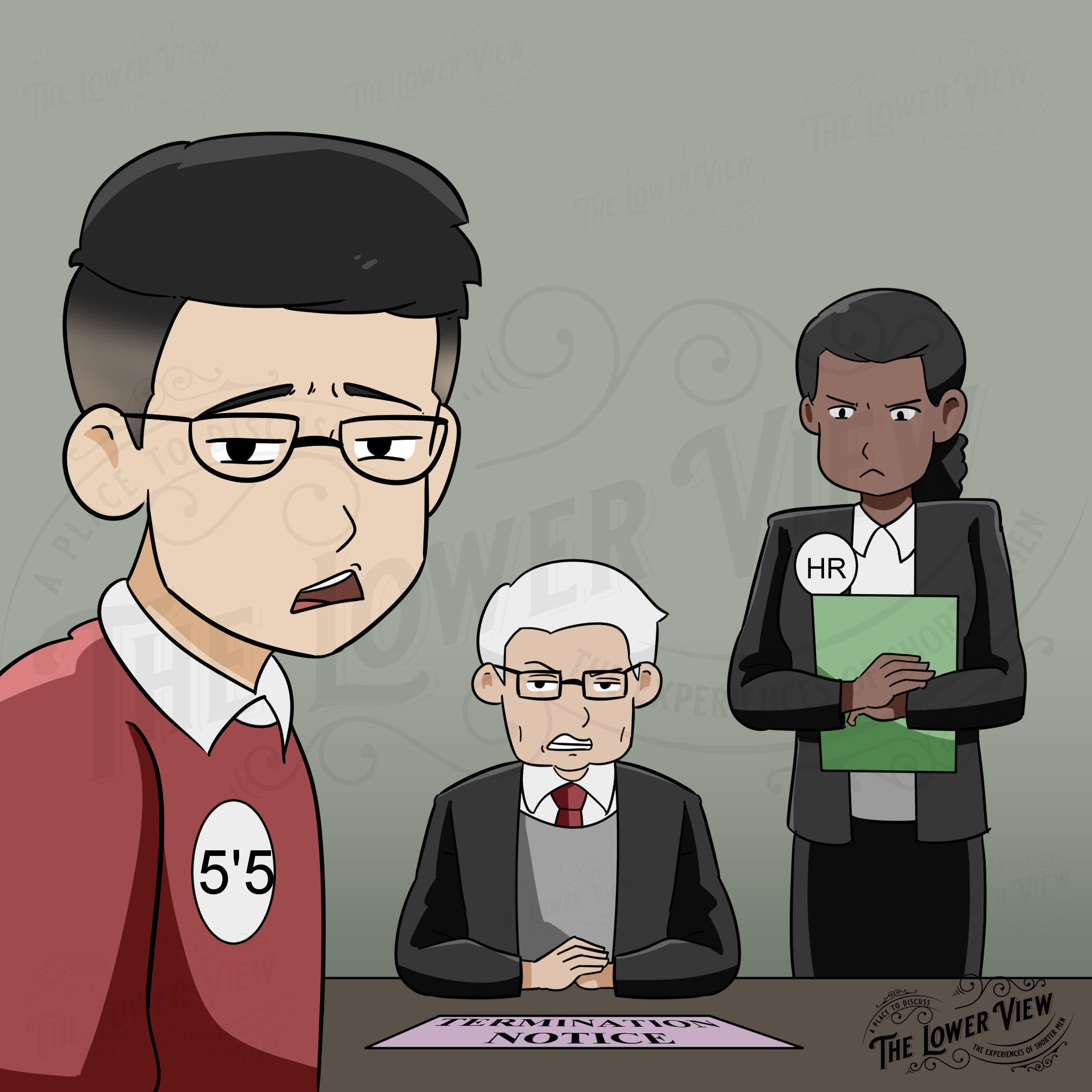
Know Your Audience And Company Policy | Source: The Lower View
Now, the “Escalate” part — going to HR or your management team is an option. As we mentioned before, if you’re in New York City or Michigan, escalating the issue may carry more legal weight because both jurisdictions specifically prohibit certain forms of height discrimination in employment. But just know that discrimination claims can be difficult to prove unless you have strong documentation or other compelling evidence. Also, consider for a moment that raising a grievance can sometimes create workplace tension, or in some circumstances, concerns about retaliation. If you win, then the outcome could be positive (return to normalcy, problem solved), or you could be viewed as “the snitch” by your detractor and other coworkers (the talking behind your back will ensue). Again, your mileage will vary, so I’d recommend only taking this approach if you are willing to go all the way. Remember, this isn’t legal advice.
Advertise With The Lower View And Reach 100,000+ Per Month!
CONCLUSION
So what will your comeback be? Will you have a comeback at all? That’s up to you. Humans are social creatures, and hierarchies exist in every species in the animal kingdom. What separates us is our ability to think beyond instinct and choose how we treat the people around us, regardless of whether we find them attractive or judge them based on their physical appearance (again, the halo effect is real). Let’s hear some of your own anecdotes. Have you ever used one of these approaches? What are some approaches you recommend? Let us know in the comments below and/or discuss it on our forums here at The Lower View! Thanks for reading!
Like This Article? Chat About It And More On Our Forum For Shorter Men!
.png)


[0 Comment]